













Technical Resources
Understand the “Why” Behind the Work
EXPERT INSIGHTS YOU CAN USE
Our technical article library is designed for commercial and industrial property stakeholders—owners, managers, REITs, and engineers—who want deeper insight into the principles, processes, and challenges behind seismic retrofitting and structural repair.
At Saunders Seismic, we believe informed decisions lead to better outcomes. That’s why we’ve created a collection of plain-language resources that explain key concepts without technical fog or sales pressure. These aren’t generic blog posts—they’re grounded in decades of field experience and created to answer the real-world questions we hear every day.
Whether you’re planning a retrofit, reviewing risk assessments, or comparing contractors, you’ll find practical guidance to help you move forward with clarity and confidence.
SEISMIC SAFETY AND STRUCTURAL REPAIR GLOSSARY
Base Isolation System
A seismic protection technique that involves separating a building from its foundation using special bearings or slip plates. This allows the building to move independently from the ground during an earthquake, reducing damage.
Cement Masonry Unit (CMU)
Commonly known as concrete blocks, cinder blocks, or gray blocks. For optimal seismic resistance, CMU walls should be grouted and reinforced with rebar. Unreinforced CMU structures may require more extensive retrofitting to achieve adequate earthquake resistance.
Concrete Tilt-Up
A construction method where large concrete panels are cast on-site and then tilted into place to form walls. This technique is common in commercial and industrial buildings.
Diaphragm
A horizontal structural element, such as a floor or roof, that distributes lateral forces from earthquakes to vertical resisting elements like walls or frames.
Displacement
The amount a building moves from its original position during an earthquake. This movement can cause significant damage if not properly accounted for in the building’s design.
Drift
The horizontal movement of a building’s floors or walls relative to each other during an earthquake. Excessive drift can lead to structural damage.
Ductility
The ability of a material or structure to deform (stretch, bend or yield) without breaking under stress. In seismic design, ductile (not rigid) structures can absorb and dissipate earthquake energy more effectively.
Earthquake
A sudden release of energy in the Earth’s crust that creates seismic waves, causing ground shaking and potential damage to structures.
Epicenter
The point on the Earth’s surface directly above the focus (origin) of an earthquake.
Glulam Beam (GLB)
Glued laminated (timber) beams, often used in commercial construction. These engineered wood products can provide strength and flexibility in building design.
Ground Acceleration
The change rate of ground velocity during an earthquake, influenced by local soil conditions. Hard soils (e.g., granite) experience less movement than loose soils (e.g., clay, sand). Higher Peak Ground Acceleration (PGA) values indicate more intense shaking and greater structural forces
H-Frame
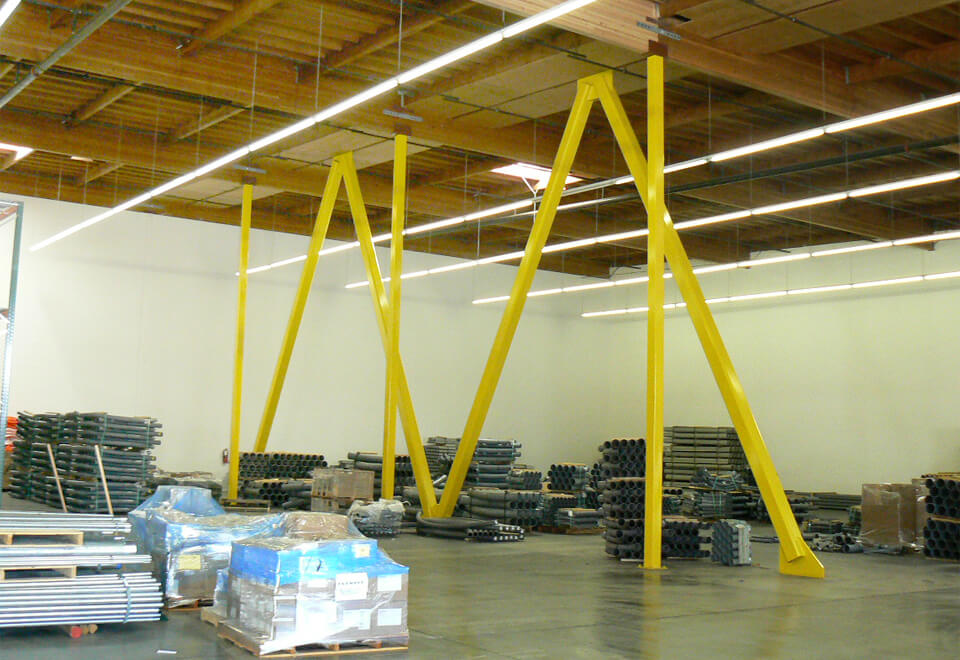
A structural reinforcement used to stabilize door, window, and other openings in industrial buildings, helping to prevent damage during seismic events.
Moment Frame
A type of structural system where beams and columns are rigidly connected, allowing the frame to resist lateral forces through bending of the structural elements.
Non-Ductile Structure
A structure that lacks the capacity for ductile behavior and is more likely to experience brittle failure during an earthquake. Older concrete buildings— especially those built before modern seismic codes—often fall into this category and are considered high-risk structures that may require seismic retrofitting.
PML (Probable Maximum Loss)
An older term used to describe potential building damage in an earthquake, now largely replaced by SEL and SUL due to inconsistencies in reporting.
Purlin
A horizontal structural member in a roof that supports the roof deck and subpurlins that help distribute loads.
Re-entrant Corner
An inward corner or notch in a building’s layout that creates a sharp inside angle—or, in some cases, a portion that protrudes outward and forms an irregular shape. These features are commonly found in “L”-shaped, “T”-shaped, or “U”-shaped floor plans. A re-entrant corner irregularity occurs when these notches extend more than 15% of the building’s overall length in two perpendicular directions. These corners can cause parts of the building to move unevenly during an earthquake, increasing the chance of stress or damage at those joints. Seismic retrofits often include reinforcement in these areas to reduce risk.
Roof Condensation
A hidden threat to structural integrity in commercial and industrial buildings, caused by moisture trapped between the roof and insulation below, inside the building. It can lead to hardware and roof nailing rusting, wood rot, mold, and structural deterioration if left unchecked.
Seismic Retrofit
The process of modifying existing structures to enhance their resistance to seismic activity and ground motion. Common techniques include adding roof-towall connections, continuity ties, and bracing, and strengthening existing connections. Additional methods may include adding concrete footings, applying fiber-reinforced polymers (FRP), shotcrete, or other specialized reinforcement techniques.
Seismic Zone
Areas defined on maps within which seismic design requirements are constant. These zones help engineers determine appropriate building standards for different regions.
SEL (Scenario Expected Loss)
A measure of potential earthquake damage with a 50% confidence level. It represents the average or expected damage during a seismic event, useful for general risk assessment and planning.
Shear Wall
A structural wall designed to resist lateral forces parallel to the plane of the wall. Shear walls are crucial in many seismic-resistant designs
Soft-Story Building
A multi-story building with a significantly weaker or more flexible level, typically the ground floor (e.g., apartments with ground-level parking, buildings with open commercial storefronts, and structures with under-building parking. These buildings are particularly vulnerable to earthquake damage and are frequently targeted for retrofitting.
Steel Frame Building
A structure with a skeleton frame made of steel, often used in high-rise construction and known for its strength and flexibility
Structural Repair
The process of restoring or improving the structural integrity of a building. This can involve fixing damage, reinforcing weakened elements, repairing damaged beams and GLB due to loading or age, or upgrading to meet the original loads unless combined with a retrofit.
Sub-Purlin
A secondary horizontal roof member that supports the roof deck (usually plywood) between main purlins, helping to distribute loads more evenly.
SUL (Scenario Upper Loss)
A more conservative estimate of potential earthquake damage, typically used for high-value properties or critical infrastructure. It represents a worst-case scenario with a higher confidence level, often 90%.
URM (Unreinforced Masonry)
Buildings usually constructed of red brick without reinforcing elements like steel bars. These structures are highly vulnerable to earthquake damage and are often prioritized for seismic retrofitting.
What You’ll Find
Breakdowns of soft-story and tilt-up building vulnerabilities
Insights into cost planning, code compliance, and project timing
Explore the articles below or reach out if you’d like help finding the most relevant resource for your building.
Seismic Retrofits
Structural Repairs
Roof Condensation
Restrictive Regulations
Design-Buildt
SEISMIC SAFETY AND STRUCTURAL REPAIR GLOSSARY
Base Isolation System
A seismic protection technique that involves separating a building from its foundation using special bearings or slip plates. This allows the building to move independently from the ground during an earthquake, reducing damage.
Cement Masonry Unit (CMU)
Commonly known as concrete blocks, cinder blocks, or gray blocks. For optimal seismic resistance, CMU walls should be grouted and reinforced with rebar. Unreinforced CMU structures may require more extensive retrofitting to achieve adequate earthquake resistance.
Concrete Tilt-Up
A construction method where large concrete panels are cast on-site and then tilted into place to form walls. This technique is common in commercial and industrial buildings.
Diaphragm
A horizontal structural element, such as a floor or roof, that distributes lateral forces from earthquakes to vertical resisting elements like walls or frames.
Displacement
The amount a building moves from its original position during an earthquake. This movement can cause significant damage if not properly accounted for in the building’s design.
Drift
The horizontal movement of a building’s floors or walls relative to each other during an earthquake. Excessive drift can lead to structural damage.
Ductility
The ability of a material or structure to deform (stretch, bend or yield) without breaking under stress. In seismic design, ductile (not rigid) structures can absorb and dissipate earthquake energy more effectively.
Earthquake
A sudden release of energy in the Earth’s crust that creates seismic waves, causing ground shaking and potential damage to structures.
Epicenter
The point on the Earth’s surface directly above the focus (origin) of an earthquake.
Glulam Beam (GLB)
Glued laminated (timber) beams, often used in commercial construction. These engineered wood products can provide strength and flexibility in building design.
Ground Acceleration
The change rate of ground velocity during an earthquake, influenced by local soil conditions. Hard soils (e.g., granite) experience less movement than loose soils (e.g., clay, sand). Higher Peak Ground Acceleration (PGA) values indicate more intense shaking and greater structural forces
H-Frame
A structural reinforcement used to stabilize door, window, and other openings in industrial buildings, helping to prevent damage during seismic events.
Moment Frame
A type of structural system where beams and columns are rigidly connected, allowing the frame to resist lateral forces through bending of the structural elements.
Non-Ductile Structure
A structure that lacks the capacity for ductile behavior and is more likely to experience brittle failure during an earthquake. Older concrete buildings— especially those built before modern seismic codes—often fall into this category and are considered high-risk structures that may require seismic retrofitting.
PML (Probable Maximum Loss)
An older term used to describe potential building damage in an earthquake, now largely replaced by SEL and SUL due to inconsistencies in reporting.
Purlin
A horizontal structural member in a roof that supports the roof deck and subpurlins that help distribute loads.
Re-entrant Corner
An inward corner or notch in a building’s layout that creates a sharp inside angle—or, in some cases, a portion that protrudes outward and forms an irregular shape. These features are commonly found in “L”-shaped, “T”-shaped, or “U”-shaped floor plans. A re-entrant corner irregularity occurs when these notches extend more than 15% of the building’s overall length in two perpendicular directions. These corners can cause parts of the building to move unevenly during an earthquake, increasing the chance of stress or damage at those joints. Seismic retrofits often include reinforcement in these areas to reduce risk.
Roof Condensation
A hidden threat to structural integrity in commercial and industrial buildings, caused by moisture trapped between the roof and insulation below, inside the building. It can lead to hardware and roof nailing rusting, wood rot, mold, and structural deterioration if left unchecked.
Seismic Retrofit
The process of modifying existing structures to enhance their resistance to seismic activity and ground motion. Common techniques include adding roof-towall connections, continuity ties, and bracing, and strengthening existing connections. Additional methods may include adding concrete footings, applying fiber-reinforced polymers (FRP), shotcrete, or other specialized reinforcement techniques.
Seismic Zone
Areas defined on maps within which seismic design requirements are constant. These zones help engineers determine appropriate building standards for different regions.
SEL (Scenario Expected Loss)
A measure of potential earthquake damage with a 50% confidence level. It represents the average or expected damage during a seismic event, useful for general risk assessment and planning.
Shear Wall
A structural wall designed to resist lateral forces parallel to the plane of the wall. Shear walls are crucial in many seismic-resistant designs
Soft-Story Building
A multi-story building with a significantly weaker or more flexible level, typically the ground floor (e.g., apartments with ground-level parking, buildings with open commercial storefronts, and structures with under-building parking. These buildings are particularly vulnerable to earthquake damage and are frequently targeted for retrofitting.
Steel Frame Building
A structure with a skeleton frame made of steel, often used in high-rise construction and known for its strength and flexibility
Structural Repair
The process of restoring or improving the structural integrity of a building. This can involve fixing damage, reinforcing weakened elements, repairing damaged beams and GLB due to loading or age, or upgrading to meet the original loads unless combined with a retrofit.
Sub-Purlin
A secondary horizontal roof member that supports the roof deck (usually plywood) between main purlins, helping to distribute loads more evenly.
SUL (Scenario Upper Loss)
A more conservative estimate of potential earthquake damage, typically used for high-value properties or critical infrastructure. It represents a worst-case scenario with a higher confidence level, often 90%.
URM (Unreinforced Masonry)
Buildings usually constructed of red brick without reinforcing elements like steel bars. These structures are highly vulnerable to earthquake damage and are often prioritized for seismic retrofitting.
What You’ll Find
Breakdowns of soft-story and tilt-up building vulnerabilities
Insights into cost planning, code compliance, and project timing
Explore the articles below or reach out if you’d like help finding the most relevant resource for your building.
Seismic Retrofits
Structural Repairs
Roof Condensation
Restrictive Regulations
Design-Buildt
HAVE A QUESTION?
-
Email:
contact@saundersseismic.com -
Phone:
(949) 646-0034 -
Office Hours:
Monday - Friday
8:00 am to 5:00 pm
CONTACT US
Follow us on social media